

SOLID IMPACT Project
From January 2025 to January 2027
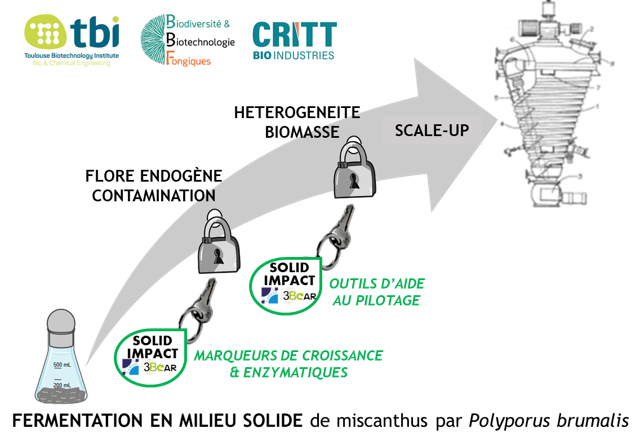
Solid-state fermentation (SSF) is a biotechnological process particularly well-suited for the cultivation of filamentous fungi on plant biomass.
The SOLID IMPACT project aims to understand the impact of two key parameters on the yield of solid-state fermentation (SSF): the level of biomass contamination by endogenous microorganisms, and the heterogeneity of the substrate and surrounding environment.
The selected model for this study is the filamentous fungus Polyporus brumalis grown on miscanthus, with the production of lignocellulolytic enzymes used as an indicator of SSF performance.
PartneRs
LoTBI (UMR INSA CNRS INRAE)
CRITT Bio-Industries (INSA)
BBF (UMR INRAE AMU)
Budget
235 k€
Funding agency

Carnot 3BCAR Institute
projeCt
ObjectiVES
The project brings together three partners—TBI, CRITT Bio-Industries, and BBF—all members of the Carnot Institute 3BCAR. This project falls within the areas of expertise titled “Biomass Production” and “Fractionation & Biorefinery”, with a strong focus on the “Process” challenge.
SSF processes offer several sustainability benefits, including applicability to a wide range of by-products from existing industries, low water consumption, and limited waste generation.
While SSF processes are relatively simple to implement at lab scale, scaling up presents several challenges, particularly those linked to the presence of endogenous flora, the heterogeneity of available biomass, and the monitoring of fungal behavior during cultivation.
SOLID IMPACT aims to answer three key questions:
-
Under what conditions is the fungus competitive for nutrient access in biomass compared to the endogenous microbial flora?
-
How do SSF operational parameters impact fungal growth and metabolic activity?
-
How can these factors be accounted for when optimizing the process during scale-up?
CRITT Bio-industries
CONTRIBUTIon
The trials conducted at CRITT Bio-Industries will test various technologies, from flasks (thin layer) to bioreactors (medium layer), to identify the key parameters for scaling up such a process. We will focus on the Polyporus brumalis fungus, known for its high production of ligno- and cellulolytic enzymes, and a model biomass for the bioeconomy that does not compete with land use for food production: miscanthus.