

AmiSynPa Project
From January 2025 to December 2026
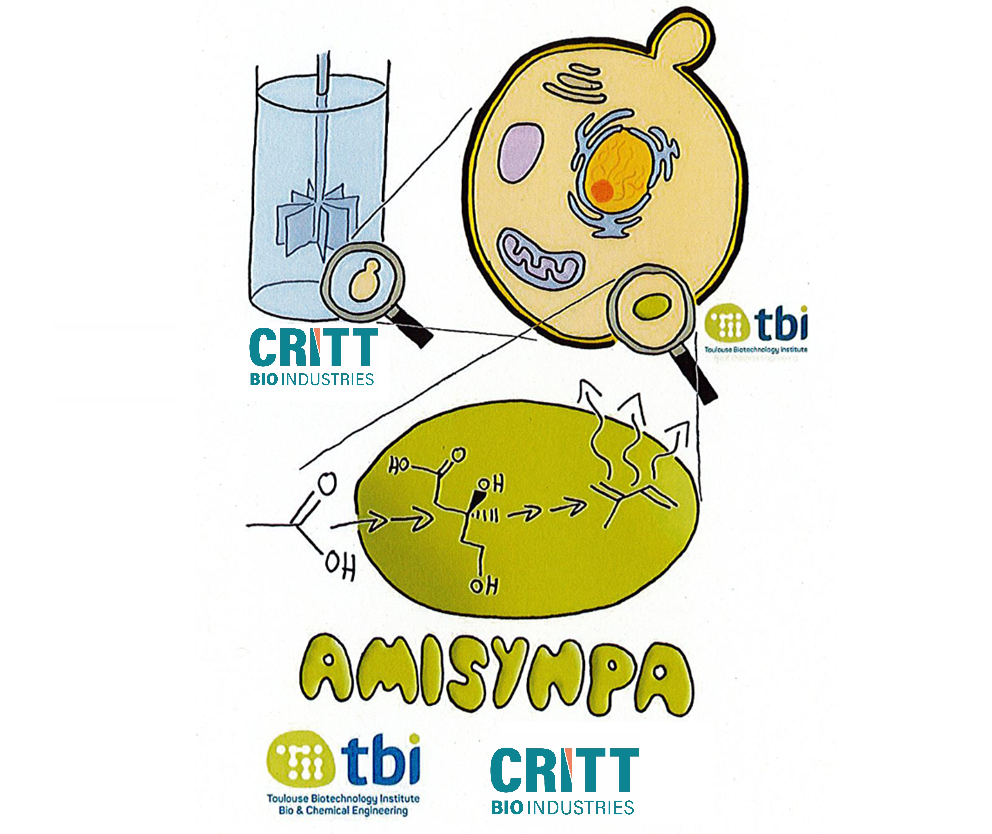
Acetyl-CoA is a key metabolite that is subject to intense competition among various metabolic pathways.
The goal of this project is to create a new cellular micro-compartment through phase separation, in order to isolate a pool of Acetyl-CoA that is independent from the rest of the cell, in two model microorganisms: Escherichia coli and Saccharomyces cerevisiae.
PartnERs
TBI (UMR INSA CNRS INRAE)
CRITT Bio-Industries (INSA)
Budget
298 k€
FUNDING AGENCY

Carnot Institute 3BCAR
projeCt
ObjectiVEs
The first aim is to target to this compartment the enzymes responsible for synthesizing mevalonate from acetate supplied in the medium — the latter being an alternative, potentially bio-based carbon source (e.g., an agricultural or industrial by-product).
In the second phase, the heterologous metabolic pathway localized within the compartment will be extended to the production of high-value isoprene. By channeling the carbon flux directly from acetate to mevalonate and then to terpenes, the project seeks to increase yields by minimizing carbon losses.
In addition to the research phase, scale-up constraints will be considered from the outset, and process profitability will be assessed.
Finally, AmiSynPa is a modular and generic project, as our innovative membrane-free compartmentalization strategy can be applied to other metabolic pathways — the terpene pathway serving as a demonstrator.
CRITT Bio-industries
CONTRIBUtion
The experiments carried out by CRITT Bio-Industries aim to develop processes that are scalable to industrial levels by addressing scale-up challenges from the very beginning. This includes identifying key parameters through implementation in bioreactors and optimizing culture and bioconversion conditions.